
On October 7, 2025, the online event “Heat Pumps in Building Renovation—Planning and Best Practice Examples for the Use of Heat Pumps in Existing Buildings” took place. Together with industry experts, participants had the opportunity to discuss how to successfully implement heat pumps in building retrofits and what annual performance coefficients are realistically achievable in practice. The event was moderated by Jens Leibold (RENOWAVE.AT). Martin Huber from the ecoplus Bau.Energie.Umwelt Cluster NÖ delivered the opening remarks.
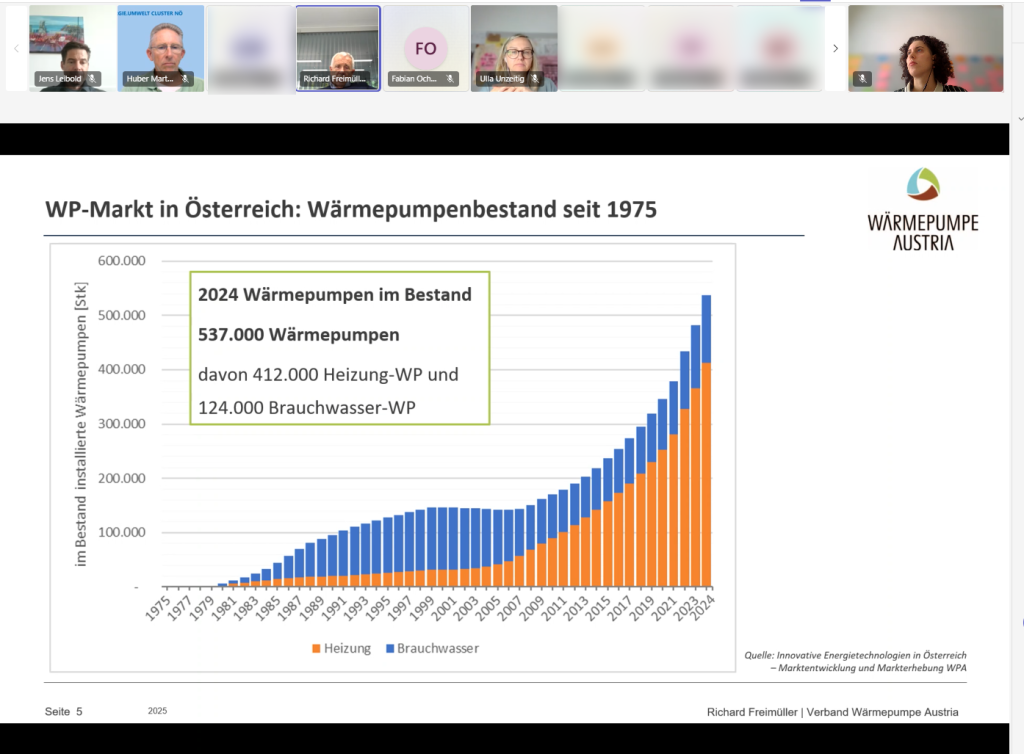
In his presentation, Richard Freimüller (Wärmepumpe Austria) demonstrated that annual performance factors (APF) are only comparable to a limited extent in practice. Values depend heavily on user behavior, system configuration, the heat distribution system, and, increasingly, on controls that are dependent on electricity prices. It also became clear that existing standards and climate data should be adapted to today’s conditions and that low flow temperatures are crucial for good efficiency.
Fabian Ochs (University of Innsbruck) supplemented this perspective with findings from current projects, including a monitoring study in Vienna-Penzing. He emphasized the importance of modular, realistic planning frameworks—especially in existing buildings with limited space and heterogeneous conditions. The JAZ alone is not the deciding factor; ultimately, it is the actual electricity bill that matters. Even individual measures, such as a targeted radiator replacement, can lower flow temperatures and lead to noticeable efficiency gains.
Discussion on Efficiency Gains and Opportunities for Optimization
Participants also discussed the real-world conditions under which heat pumps can operate most efficiently in existing buildings. The discussion focused on questions such as: What factors influence actual performance in everyday use? How do user behavior, the quality of the installation, and the selected flow temperatures affect energy consumption? Challenges in older buildings, the proper handling of existing radiators, and the importance of careful sizing were also discussed. Particular emphasis was placed on the role of installers, whose knowledge and experience are a key factor in achieving good efficiency and reliable operating performance. It became clear that heat pumps realize their full potential above all when planning, installation, and operation are well coordinated—and when lessons learned from real-world projects are consistently incorporated into future retrofits.